

What is green and crunchy — and might help high schoolers unlock a future career?
At Lord Botetourt High School, that answer came in the form of fresh, homegrown lettuce cultivated right in the classroom. Through a partnership with Virginia Western Community College (VWCC), science teacher Grace Parker and her students participated in a hands-on hydroponics lab this fall, led by VWCC program coordinator Cynthia Fairbanks.
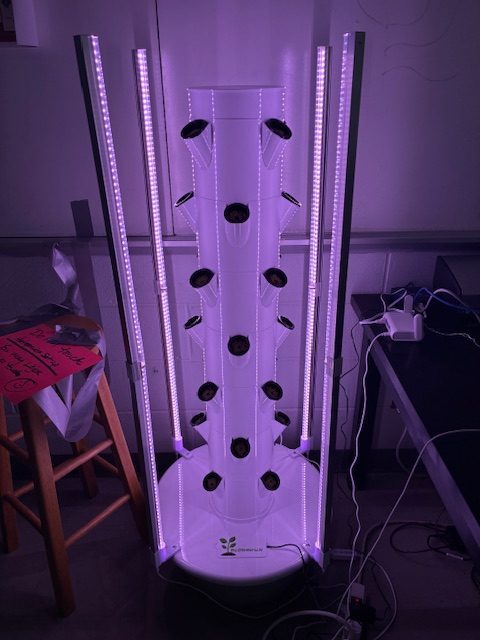
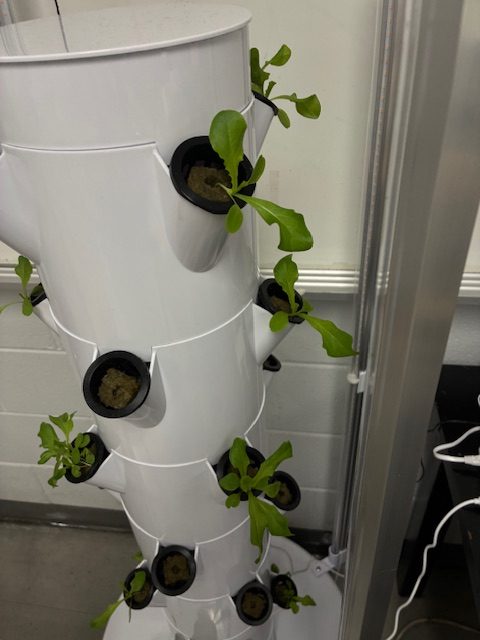
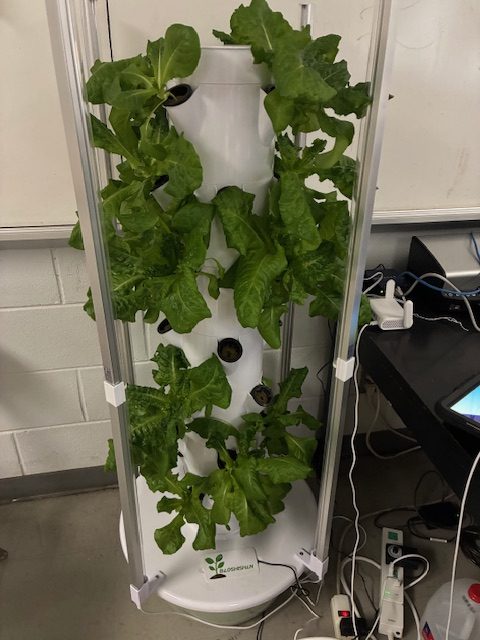
As part of the program, students built and maintained a hydroponics tower, using sensors to collect and interpret data as they grew Buttercrunch lettuce over a five-week period. When the plants were ready, the class celebrated by harvesting the greens and making fresh salads — enjoying the fruits (and leaves) of their labor.
Many Lord Botetourt students participating in the hydroponics lab said they were most surprised by how quickly and efficiently lettuce grows in a hydroponic system compared to traditional farming when asked about the experience.

“I was surprised at how easy and fast the lettuce grew,” student Alex Barbour said when asked about the project. “Compared to traditional gardening it takes little to no work. All you have to do is plant seeds, add water with nutrients, and adjust the pH (scale). I thought it was way more complex than it was and, when compared to my garden, I enjoyed this way more.”
Parker said the hydroponics project gave students the opportunity to explore new agricultural technology while connecting it directly to key biology concepts and Standards of Learning (SOLs).
The project incorporated Science and Engineering Practices, Water Chemistry, Photosynthesis, Flow of Energy, Nutrient Cycles, and Computational Thinking. VWCC provided the classroom setup, which included a hydroponics tower with a water pump, grow lights, and networked technology to collect and display real-time data as the plants grew.
Students used an iPad to monitor this data throughout the four- to six-week project. For many participants, it was their first experience growing plants, and they were particularly engaged by the technology involved. Parker noted that even students not enrolled in the class stopped by regularly to check on the lettuce’s progress.
When the class discovered the pH levels were off one week, students used a pH probe to diagnose the issue and, with guidance, learned how to correct it by adjusting the water source from faucet water to filtered fountain water—an experience that deepened their understanding of both plant science and problem-solving in real-world applications.

All this is possible thanks to an Advanced Technological Education grant that the National Science Foundation awarded to Virginia Western last year to develop connections between the college’s Agriculture and Mechatronics programs. The Cross-Pollination Skillsets project focuses, in part, on building Virginia’s workforce in controlled environmental agriculture.
“We created this program to allow high-school students to see a real-life project combining agriculture and technology,” Fairbanks said in a recent press release. “The program teaches some amazing hands-on skills with technology and agriculture and opens the conversation of data literacy.
“This hydroponic program gives students a new take on agriculture, because so many high school-age students think agriculture is conventional farming. This opens their eyes that their interest in technology can be directly applicable to modern farming techniques.”
During the five-week project, Fairbanks visited the classroom weekly for 15-minute lessons using the hydroponic tower, a vertical set-up with 28 grow cups, a pump and an LED light source. The NIWA Grow Hub monitors humidity, temperature, light levels and more; the class programs through the NIWA unit to keep the pump and lighting on a roughly 16-hour timer per day. Nutrients added to the water in the tower’s base provided a way of growing food without soil.
Students were assigned plants to monitor, and each week, they checked leaf growth and eventually tasted the lettuce to determine ideal harvesting time. In addition, an iPad left in the classroom was connected to the NIWA Grow Hub, which allowed students to see the data’s progression.

Photos courtesy of Grace Parker
Those whose interest is piqued are invited to learn more about Virginia Western’s Ag-Tech associate degree pathway, which develops hands-on applied engineering skills alongside agricultural knowledge and practice.
Virginia Western’s Ag-Tech team of Fairbanks, Dr. David Berry and Dr. Mallory White are prepared to help students determine their higher education goals and be a support if they enter the Ag-Tech pathway. They can share more about potential career opportunities such as working in a Controlled Environmental Agriculture facility doing hydroponics full-time, working in manufacturing in an agriculture setting, or being an equipment technician or farm manager.
“Virginia Western is thrilled to pioneer this transformational programming in our region,” said VWCC Dean of STEM and Botetourt County Board of Supervisors Chair Amy White. “The opportunity to blend technology, agriculture and food production while partnering with local high school students and faculty aligns directly with our mission and serves to increase opportunities for our community.
“Virginia Western is proud of our innovative approach to workforce and talent development, and we hope to expand this, and other, programs in the future. I want to celebrate the hard work of our team who has put this programming together, as well as the three high school classrooms for being fabulous partners.”
~ Fincastle Herald staff report


